A waitress finishing a double shift. A bartender working late into the night. A hotel worker greeting guests before sunrise. These are the hardworking Americans who rely on tips to make ends meet.
That is why a Republican-controlled Congress passed “No Tax on Tips” as part of the Big Beautiful Bill last year.
Congressional Republicans recognized that for too long, Washington has talked about helping working families while leaving in place a tax code that quietly penalizes some of the people who work the hardest.
Tipped workers often earn modest base wages and depend on gratuities to cover rent, groceries, childcare, and transportation.
The federal No Tax on Tips legislation is rooted in a simple principle: if you work for your money, you should keep more of it.
For millions of servers, bartenders, hotel workers, and delivery drivers, that means real relief immediately. For a tipped worker, it could mean $1,300 more in their pocket each year.
While Congress is moving in that direction to help working families, Illinois is moving the opposite way.
Illinoisans already face one of the highest tax burdens in the nation.
Think about a working mom driving to her lunch shift.
She fills up her car and pays one of the highest gas taxes in America, plus sales tax on top of it. If she drives through a tollway, she pays again. On the way, she calls her mother, on a phone taxed at the highest rate in the nation.
After work, she heads home to an apartment where rising property taxes are baked into her rent, even if she does not own a home. Her electricity and natural gas bills are higher because Illinois layers taxes and fees on energy.
After the kids are in bed, she relaxes with her favorite show, which in certain cities comes with an “amusement tax.”
At every turn, government takes a cut.
And Springfield wants to make sure it takes a cut of her tips, too.
That five-dollar bill a customer left her for being friendly and hustling through a rush. Does the state really need to take from that as well?
Last year, Governor J.B. Pritzker and the General Assembly passed legislation to decouple Illinois’ tax code from federal tax policy, leading to raised taxes, a less competitive workforce, and an increased unemployment rate. While other states align their codes with federal rules to remain competitive, Illinois chose a different path.
Supporters called it “decoupling.” Illinois families and businesses experience it as a tax increase that makes the state more hostile to investment and growth.
While other states cut taxes to spur growth, Illinois doubled down on higher rates.
And the impact shows.
While the national economy added hundreds of thousands of jobs last year, Illinois actually lost jobs. The state trails neighboring Indiana, Wisconsin, and Missouri in job creation and population growth. When taxes are higher and policies are punitive, workers do not get hired and families do not put down roots.
That trend hits hardest in communities already facing barriers to opportunity, including African American workers and those without college degrees who contend with higher unemployment compared with neighboring states.
Earlier this year, I introduced legislation, HB 4519, to create an income tax deduction for gratuities included in a taxpayer’s federal adjusted gross income. It would be effective immediately and would mirror the commonsense direction Congress is taking.
Every dollar a server keeps circulates through local economies at grocery stores, childcare providers, clothing shops, and neighborhood restaurants, strengthening communities and broadening the tax base.
When government helps hardworking people keep more of what they earn, families thrive. When government piles on taxes, whether by decoupling from federal law or insisting on taxing tips, workers struggle and the state’s economy suffers.
Critics will argue that Illinois “can’t afford” to stop taxing tips. But the real question is whether Illinois can afford to keep driving people out of the state.
Families move to places where paychecks go further and taxes are lower. Businesses choose where to expand. Workers choose where to build careers.
When Illinois remains a high-tax outlier, growth happens somewhere else.
Allowing workers to keep more of their tips does not drain the economy. It strengthens it.
Under Republican leadership, the federal government is moving back toward policies that respect work and growth. Illinois should not be left behind, clinging to a tax-and-spend model that has already failed.
I encourage my colleagues in Springfield to give HB 4519 a fair hearing. And I urge the governor to reconsider his opposition to no tax on tips.
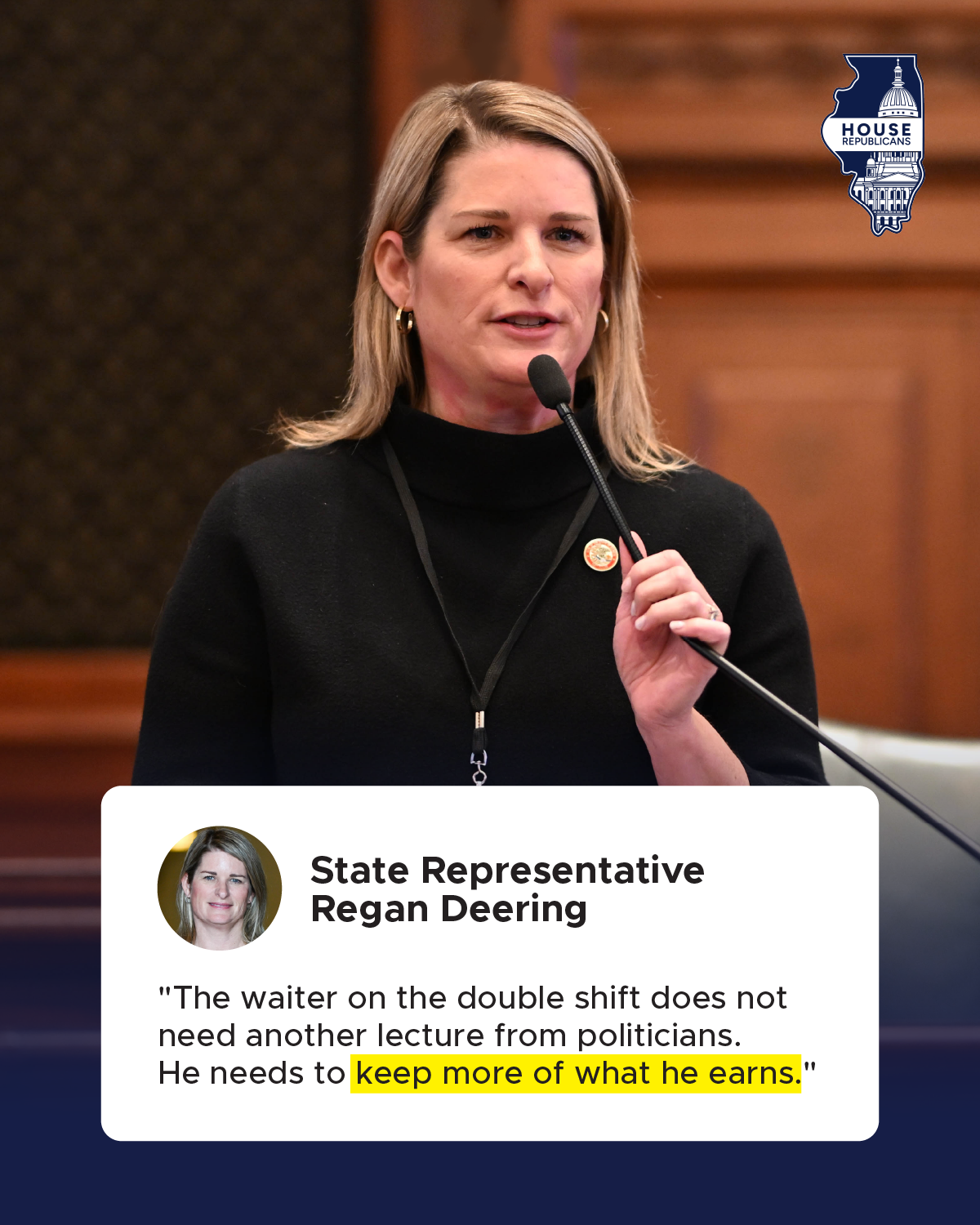
The waiter on the double shift does not need another lecture from politicians. He needs to keep more of what he earns.
The federal government is doing its part. Now it is time for Springfield to do the same.
###